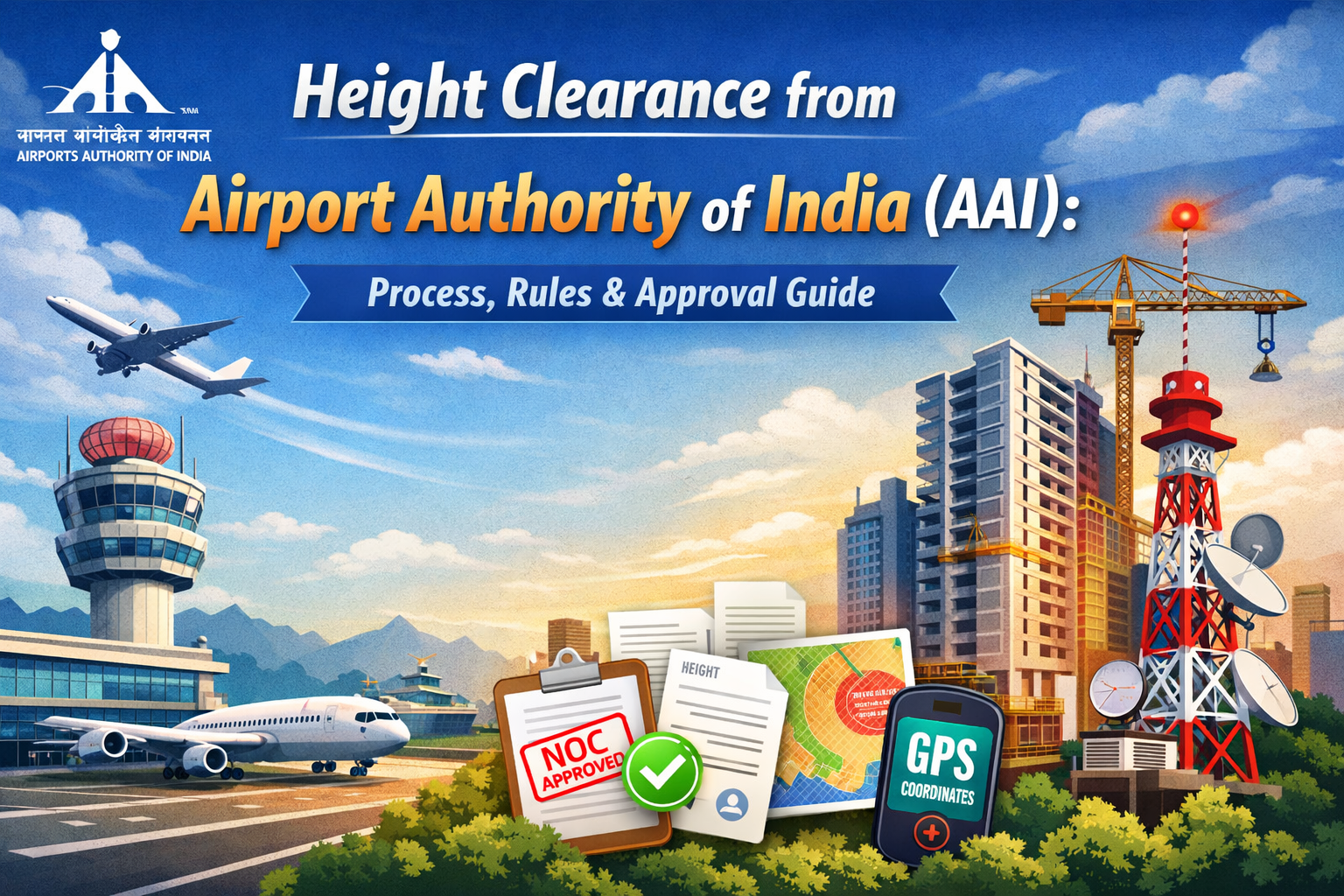
Height clearance from the Airport Authority of India (AAI) is a mandatory safety compliance measure for any building or structure proposed near civil airports in India. The main objective is to ensure that tall structures do not interfere with aircraft operations, navigation, and flight safety. The process is governed by the Ministry of Civil Aviation’s “Height Restrictions for Safeguarding of Aircraft Operations” Rules, 2015, issued under the Aircraft Act.
Why Height Clearance is Necessary
Airports operate within a protected airspace that includes critical zones such as approach/take-off paths, transitional surfaces, and other obstacle limitation surfaces (OLS). These invisible planes and surfaces extend upwards and outwards from runways and navigation facilities. Any structure that intrudes into these surfaces can become a hazard to aircraft during landing, take-off or low-altitude flight.
The rules are in place to protect aviation safety, navigation signals, and Communication, Navigation and Surveillance (CNS) equipment. Even vegetation or cranes that exceed permissible heights can create risks if they breach these surfaces or interfere with radio/flight instruments. Failure to comply may result in demolition or mandatory trimming of the obstructions as per safety regulations.
Where Height Clearance Applies
Height clearance requirements apply to structures within a defined radius from an airport’s Aerodrome Reference Point (ARP):
Up to 20 km from ARP for Visual Flight Rules (VFR) airports.
Up to 56 km from ARP for Instrument Flight Rules (IFR) airports.
If the structure lies beyond these distances and is under 150 meters above ground level (AGL), AAI clearance may not be mandatory.
Colour Coded Zoning Map (CCZM)
To simplify planning and compliance, AAI publishes Colour Coded Zoning Maps (CCZM) for areas surrounding many airports. These maps depict permissible top elevations above mean sea level (AMSL) using a grid system. Local bodies and developers can use the map to check if a proposed building height is within safe limits. If the required height does not exceed the permissible top elevation shown on the CCZM, no NOC from AAI may be necessary.
However, if the requested elevation is higher than the CCZM limit, an NOC (No Objection Certificate) must be obtained through the formal application process.
The Height Clearance (NOC) Application Process
AAI has introduced an online system called NOCAS (No Objection Certificate Application System) for height clearances. This portal is the official way to apply for an NOC for buildings, masts, billboards, chimneys, power transmission lines, communication towers, and similar structures.
Step-by-Step Process:
Register on NOCAS:
Visit the AAI NOCAS portal and complete the applicant registration.
Fill and Submit Application:
Provide details such as location, type of structure, proposed height, coordinates in WGS-84 format, and elevation above mean sea level (AMSL).
Upload Required Documents:
Key documents generally include:
Certified GPS coordinates and site elevation.
Detailed building/structure design documents.
Authorization letter (if the applicant is not the owner).
Unique Application ID:
After submission, you receive a unique NOC ID.
Document Scrutiny:
A designated AAI officer at the nearest airport scrutinizes the application before forwarding it to the Regional NOC Cell for technical evaluation.
Safety Assessment:
AAI evaluates the application against ICAO Annex 14 obstacle limitation criteria, CNS requirements, and instrument flight procedures to determine whether the structure will infringe on any protected surface.
Decision:
The authority may issue:
NOC for the requested height, possibly with conditions.
NOC for a restricted height lower than requested.
Objection with reasons, if the structure poses a risk.
Communication & Tracking:
The applicant is informed electronically and can track the application status online.
After NOC Issuance
Once the NOC is issued, approval from municipal/local planning authorities is needed to proceed with construction permitting. Local bodies must ensure that the building plan complies with AAI’s height restrictions before granting building permits.
If the applicant is not satisfied with the issued NOC (e.g., restricted height), they may apply for review or appeal through NOCAS.
Important Compliance Notes
No construction should begin before an NOC is issued — this is a compliance requirement and part of the statutory application conditions.
Projects violating height limits or proceeding without clearance may face action under applicable safety laws.
Local building authorities increasingly integrate CCZM and AAI rules into their bylaws to enforce aviation safety.
Summary:
Height clearance from AAI is a critical safety prerequisite for any tall structure proposed near an airport in India. Using the NOCAS online system, applicants can efficiently apply for and obtain necessary clearance based on scientific assessments of site coordinates, elevation, and aviation safety criteria. This system — supported by Colour Coded Zoning Maps and robust rules — helps balance urban development with aviation safety.
About the Author