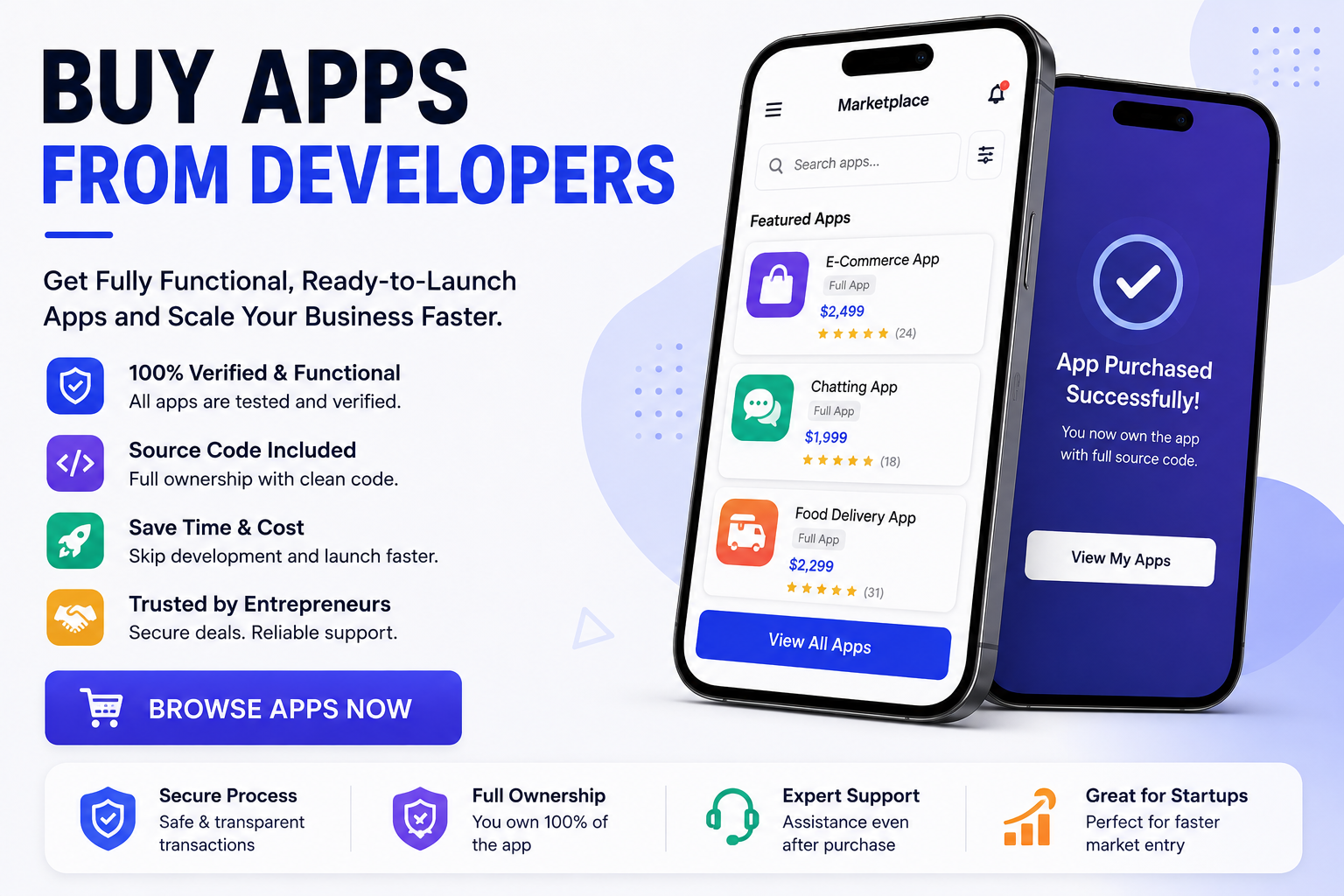
A few years back, a client of mine wanted a food delivery app up and running in six weeks. Six weeks. His developer quoted him four months just for the MVP, and that is when he came to me asking if there was a faster way. There was. Buy an existing app, get the source code, tweak the branding and features, and launch. He saved roughly three months and a decent chunk of his budget. That is the whole appeal in a nutshell.
Buying apps from developers is not some shortcut for people who do not want to “do it right.” It is a legitimate business decision that plenty of smart founders and agencies make every single week. But here is the thing nobody tells you upfront: the buying process is full of small print, licensing quirks, and ownership questions that can bite you later if you do not ask the right things before you pay.
I have sat on both sides of these deals, helping buyers vet source code and helping sellers structure fair licenses. So let us walk through what actually matters.
Key Takeaways
- Buying an app can save a lot of time and money as compared to building from scratch, but licensing terms vary a lot between sellers.
- Access to source code gives you far more flexibility than a ready to launch app.
- White label apps are good for speed but know you may be sharing a code-base with other buyers.
- Always have ownership, IP rights and support terms in writing, before you pay.
- Hidden costs like hosting or API fees can sneakily double your budget if you don’t ask in advance.
What Does It Mean to Buy an App From a Developer?
Essentially you buy an app from someone who has already built it. You get the finished product, the source code that powers it or both. “You don’t have to get a team to build from ground up. You are entering the realm of something that already exists, a code base that is already working, sometimes with a live user base, sometimes just a solid technical base that you can build on.
This is different than custom mobile app development where a team develops your app from scratch as per your requirements. When you buy an app source code, you are inheriting someone else’s architecture, decisions and sometimes their bugs as well.
Why Businesses Buy Ready Made Apps
Speed is the obvious reason, but it is not the only one. Cost matters a lot. Building an app from scratch with a skilled team can run into tens of thousands of dollars before you even test it with real users. A ready made app skips that entire discovery and prototyping phase.
There is also the risk factor. Founders who have never shipped software before often feel more comfortable customizing something proven than gambling on an unproven build from a freelancer they found last week. I have seen agencies buy apps from developers specifically because it lets them serve five clients in the time it would take to build one custom product.
And honestly, some people just want to test an idea fast. If you are not sure your niche delivery app or booking platform will even get traction, why sink six figures into custom development first?
Source Code vs. Ready to Launch App
This trips up a lot of first time buyers. A ready to launch app usually means the app is functional, maybe even branded, and you can publish it to app stores with minimal changes. Buying the source code, though, gives you the actual files, the raw material a developer can modify, extend, or rebuild parts of.
Some sellers offer both as separate packages. You might pay less for just the app itself if you only need it running as is, or pay more to get full source code access so your own developers, or theirs under contract, can go in and change things.
If you plan on scaling, adding features later, or rebranding heavily, you want the source code. If you just need something working today with zero technical involvement, a ready made app might do the job on its own.
Understanding App Licensing
Licensing is where things get genuinely confusing, and honestly it is the part buyers skip reading most often. It is a mistake. The license determines what you are legally allowed to do with what you bought.
Some developers sell a single use license, meaning you can deploy that code for one business, one app store listing, one product. Others sell resale or multi use licenses, common in white label deals where you are expected to rebrand and resell the same base app to multiple clients.
Terms vary a lot depending on who is selling. A solo developer on a marketplace might have a two paragraph license. An established software company might hand you a twenty page agreement. Read it. Actually read it, not skim it.
What Rights Do You Actually Get After Buying an App?
This is the question I ask every buyer before they wire any money. “Buying” an app does not automatically mean you own it outright in every case. You might get:
- Full ownership, including the right to modify, resell, and rebrand freely
- A license to use and customize, but not resell the base code to others
- Rights limited to a specific platform, region, or number of installs
None of these is inherently bad. It depends what you need. An agency planning to resell a white label app to twenty clients needs very different rights than a startup building one product for its own use. Ask directly, in writing, what happens after the purchase. Do not assume.
White Label Apps vs. Fully Custom Apps
| Factor | White Label App | Fully Custom App |
| Time to launch | Days to a few weeks | Months |
| Cost | Lower upfront | Higher upfront |
| Uniqueness | Shared base with other buyers | Built specifically for you |
| Customization depth | Branding, some features | Unlimited, built to spec |
| Best for | Agencies, fast market testing | Established businesses, unique products |
| Ownership terms | Often licensed, not owned outright | Usually fully owned |
A white label app is basically a template with your logo placed on it and maybe a few tweaked features. It is not a bad thing. It just means other businesses might be running the same core code with different branding. If your competitive edge is something other than the app itself, such as service, pricing, or local presence, that is usually fine.
How App Customization Works
Once you have bought the app or its source code, customization is where developers earn their fee. Some sellers include a set number of customization hours in the purchase price. Others charge separately, and you will want a developer, either the seller’s team or your own, to actually go into the codebase and make changes.
The depth of customization possible depends heavily on how the original app was built. Clean, well documented code is a dream to work with. Messy, undocumented spaghetti code is a nightmare, even if the app “works” on the surface. I always tell buyers to request a code walkthrough or at least a documentation sample before finalizing.
Features You Can Usually Customize
Most ready made apps allow changes to things like:
- Branding, colors, logos, and app store listings
- Payment gateway integrations
- User onboarding flow
- Push notification triggers
- Language and localization settings
- Third party API connections such as maps, analytics, and chat tools
Deeper structural changes, like switching the entire database architecture or rebuilding core app logic, are possible but get expensive fast, and sometimes it is genuinely cheaper to build custom at that point.
What to Check Before Buying an App
Before you buy app source code from anyone, check the following, no exceptions:
- Is the code recently updated and compatible with current OS versions?
- Does it use outdated or deprecated libraries?
- Is there documentation, even basic?
- Has the app passed app store review before, including iOS and Android specific quirks?
- What backend or server setup does it require?
- Are there existing bugs or known issues the seller should disclose?
I once watched a buyer skip step one and inherit an app built on a framework that Apple had basically stopped supporting. Six months of “quick customization” turned into a near total rebuild.
How Much Does It Cost to Buy an App From Developers?
Prices swing wildly. A basic white label app might run a few hundred to a couple thousand dollars. A more robust, feature rich app with source code and support could run into the tens of thousands. Fully custom builds, obviously, go higher still.
I will not throw out specific numbers as gospel because pricing genuinely depends on the developer, the app’s complexity, the market it is built for, and what is included in the deal. Always get a breakdown of exactly what your money covers.
Hidden Costs Buyers Should Watch For
This is where budgets quietly blow up. Watch for:
- Server and hosting costs not included in the purchase
- Third party API fees such as maps, payment processors, and SMS services
- App store developer account fees
- Ongoing maintenance or update packages
- Customization work billed separately, hour by hour
A cheap upfront price with expensive add ons everywhere else is not actually cheap. Ask for the full picture before signing anything.
Source Code Ownership and Intellectual Property
Intellectual property questions deserve their own conversation with the seller, not an assumption. Who owns the code after purchase? Can you patent features built on top of it? Can the original developer resell the same base code to a competitor of yours right after your deal closes?
These are not paranoid questions. They are standard due diligence. A trustworthy seller will have clear answers, ideally documented in the sales agreement, not just verbal promises in a chat thread.
Security, Scalability, and Technical Support
An app that looks great in a demo can fall apart under real traffic. Ask how the app handles scaling, what security measures are built in, including encryption, secure authentication, and data protection compliance, and whether the seller offers post purchase support.
Support terms vary hugely. Some sellers include thirty or ninety days of bug fixes. Others sell it as is with zero support, which is fine as long as you know that going in and have your own developer ready to take over.
How to Choose a Reliable App Developer or Software Seller
Look at their track record, not just their portfolio screenshots. Ask for references or examples of apps they have sold that are still running successfully. Check reviews on marketplaces if that is where you found them. A seller who is cagey about answering technical questions or dodges licensing details is a red flag full stop.
Common Mistakes When Buying App Source Code
The biggest one? Not testing the app thoroughly before buying. Demo videos hide a lot. Another common mistake is assuming source code included means full ownership, not budgeting for customization costs, and skipping a written contract in favor of a handshake deal over email.
Buy an App or Build From Scratch: Which Option Makes More Sense?
If you value speed and budget over uniqueness, then buying is the way to go. If your business model is entirely dependent on proprietary technology or a very specialised user experience that nobody else can provide, then it’s probably worth the added time and expense to go with custom mobile app development. Many companies do both. They buy something to get off the ground quickly, then once they have validated the market they invest in custom development.
Final Checklist Before You Purchase
- Confirm exactly what you are buying: app, source code, or both
- Read the license fully and ask questions about anything unclear
- Clarify ownership and resale rights in writing
- Get a code and documentation review
- Ask about hidden costs such as hosting, APIs, and support
- Confirm what customization is included versus billed separately
- Check the seller’s reputation and past deals
Final Thoughts
Buying an app from a developer can genuinely be one of the smartest moves a startup or agency makes, but only if you go in asking the right questions. Do not let a slick demo rush your decision. Read the license, clarify ownership, budget for the hidden costs, and get everything in writing. If you are currently weighing whether to buy a ready made app or start custom development, take the time to vet a few sellers first. The extra hour of due diligence now can save you months of headaches later.
FAQs: Buy Ready Made Mobile Apps
Can I resell an app I purchased from a developer?
That really is dependent on the license. Some can be resold, some are only allowed for your own use. Never assume, always check.
Is it legal to buy app source code?
Yes assuming the seller had rights to sell it and you are operating within the licence terms you agreed to.
How do I know the quality of the source code?
Request a sample, documentation or developer review prior to purchase.
So you bought an app. Do you still need a developer?
Usually, yes, at least for customisation, updates and ongoing maintenance, unless the vendor includes support as part of the package.
What’s the difference between a white label application and a custom application?
A white label app is a generic product that you rebrand as your own. A custom app is custom built from scratch for your business.
Do you pay anything after buying an app?
Yes, often. These could include hosting, third party API fees, app store fees and any potential support or update packages.
Can I trust marketplace sellers for buying source code?
Many are legit but do your due diligence. Check reviews, ask for references and make sure you understand the licensing terms before you pay anything.
About the Author